

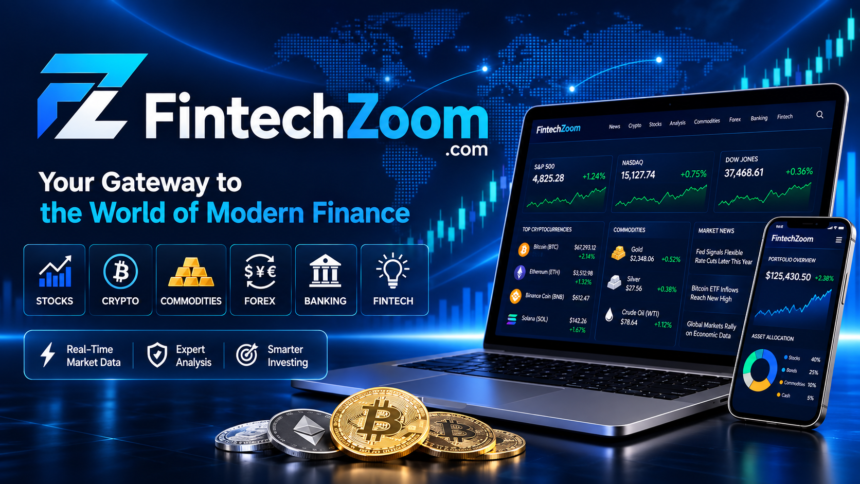
The term FintechZoom.com Nasdaq usually refers to Nasdaq-related market information, news, explanations, and analysis available through the FintechZoom financial website. It does not mean that FintechZoom owns Nasdaq or operates the Nasdaq stock exchange. Instead, people often search for phrases such as FintechZoom Nasdaq, Nasdaq FintechZoom, or FintechZoom.com Nasdaq today when they want an easier way to understand what is happening in the technology-heavy part of the U.S. stock market. The website can help readers follow market movements, major companies, index performance, economic developments, and changes that may influence investor confidence. This can be useful because the Nasdaq market can sometimes look confusing to a beginner. A person may see an index moving higher or lower but still not understand what caused the change. Reading market explanations alongside price information can make those movements easier to understand and place them in a wider context.
FintechZoom Nasdaq information can therefore be viewed as a starting point for learning about the market rather than as a separate financial product. Readers may use it to understand the Nasdaq Composite, the Nasdaq-100, technology stocks, artificial intelligence companies, semiconductor businesses, interest-rate changes, company earnings, and other forces that can move share prices. For example, imagine that several large technology companies report stronger-than-expected earnings during the same week. The Nasdaq may rise because investors become more confident about future growth. A reader looking only at the final percentage change may know that the market went up, but someone reading a broader FintechZoom.com Nasdaq explanation may also learn why earnings, expectations, interest rates, and investor mood played a part. This is where financial information becomes more useful: it changes a simple market number into a story that readers can understand.
FintechZoom Nasdaq Composite vs Nasdaq-100: What’s the Difference?
One of the most useful things to understand when reading FintechZoom.com Nasdaq content is that the Nasdaq is not just one single index. The word Nasdaq can refer to the stock exchange itself, the Nasdaq Composite, or the Nasdaq-100. The Nasdaq Composite includes a very large number of companies listed on the Nasdaq exchange, which makes it a broad picture of the market. The Nasdaq-100 is more selective. It focuses on 100 of the largest non-financial companies listed on Nasdaq. This is why the Nasdaq-100 often receives attention when people discuss large technology and growth companies.
The difference matters because the two indexes can move differently. A strong day for a few giant technology companies may have a larger effect on the Nasdaq-100, while the Nasdaq Composite reflects a wider group of companies. When reading Nasdaq FintechZoom analysis, it is therefore important to check which index is being discussed. Beginners sometimes see “Nasdaq up 1%” and assume every Nasdaq-listed company rose by the same amount. That is not how an index works. An index is a combined measurement, and individual stocks inside it can move in very different directions.
| Nasdaq Term | Simple Meaning |
|---|---|
| Nasdaq Stock Market | The actual electronic stock exchange |
| Nasdaq Composite | Broad index of many Nasdaq-listed securities |
| Nasdaq-100 | 100 major non-financial Nasdaq-listed companies |
| FintechZoom Nasdaq | Coverage and analysis about Nasdaq markets |
| Index movement | Combined performance, not every stock moving equally |
| Main beginner lesson | Always check which Nasdaq index is being discussed |
How to Use FintechZoom.com Nasdaq to Track the Market
A useful way to read FintechZoom.com Nasdaq today information is to look beyond whether the market is simply green or red. Start by checking the index level, percentage change, trading direction, and the main news affecting investors. Then compare the daily move with the wider trend. A one-day fall can look dramatic but may be small when compared with the previous month or year. In the same way, one strong trading session does not always mean that a long-term decline has ended. Looking at several time periods can give a clearer picture of where the market may be heading.
Consider a simple case study. Imagine the Nasdaq drops sharply in the morning after an inflation report, but later recovers most of the loss. A beginner might only notice that the index finished slightly lower. A more careful reader would look at the full day and see that investors first became worried about interest rates and then became more confident as they studied the report. This shows why context matters. FintechZoom Nasdaq market tracking can be more useful when readers connect price changes with news, company results, economic reports, and investor expectations instead of treating every movement as an isolated event.
What Moves the Nasdaq? Key Factors Investors Should Watch
Several forces can move the Nasdaq, and interest rates are among the most important. Many Nasdaq companies are valued partly on how much profit investors believe they may earn in the future. When interest rates rise, future profits may look less valuable in today’s terms, which can put pressure on high-growth stocks. Inflation reports, central-bank decisions, employment data, economic growth, and bond yields can therefore have a strong effect on the market. This explains why the FintechZoom.com Nasdaq conversation often goes beyond technology news and includes broader economic events.
Company earnings are another major factor. When a large company reports stronger revenue, higher profits, or a positive business outlook, investor confidence can rise. Weak results can have the opposite effect. Artificial intelligence spending, semiconductor demand, cloud computing, digital advertising, software sales, and consumer spending can also influence Nasdaq companies. A useful lesson is that prices often move because investors are changing their expectations about the future, not simply reacting to what has already happened.
Markets often react more strongly to expectations than to old information.
For example, a company may announce record profit but still see its share price fall. This can happen when investors expected even better results. Understanding this difference between actual results and market expectations makes Nasdaq movements much easier to understand.
Top Stocks and Sectors Behind FintechZoom Nasdaq Performance
Technology receives much of the attention around the FintechZoom Nasdaq because many influential companies listed on Nasdaq operate in areas such as software, semiconductors, artificial intelligence, cloud computing, digital services, e-commerce, and communications. However, Nasdaq should not simply be described as a technology-only market. It also contains companies from healthcare, biotechnology, consumer services, industrial industries, and other areas. Still, large technology businesses can have a strong influence on major Nasdaq indexes because of their size.
This concentration can create both opportunity and risk. When several large growth companies perform well at the same time, they can help lift the overall index even if many smaller companies are struggling. The reverse can also happen. A sharp decline in a handful of major companies can pull an index lower even when some smaller stocks are rising. This is why people reading FintechZoom.com Nasdaq market news should not judge the health of the entire market from the index number alone. Looking at how many companies are rising, which sectors are leading, and whether market gains are broad or concentrated gives a much richer picture.
Is FintechZoom.com Nasdaq Reliable for Investment Research?
FintechZoom.com Nasdaq can be useful as one source for understanding market topics, especially for readers who want financial ideas explained in a more accessible form. Market articles can help people learn the meaning of indexes, understand economic events, follow major sectors, and recognize why certain stocks may be moving. For beginners, this can make financial markets feel less complicated. Still, no single financial website should be treated as the only source of information before making an important money decision.
Readers should separate facts, analysis, forecasts, and opinions. A market price is a piece of data. An explanation of why the price moved is analysis. A statement about where the market may go next is a forecast, and forecasts can be wrong. This distinction becomes especially important when reading articles about future Nasdaq performance. A careful reader checks important figures, compares different viewpoints, studies company reports when relevant, and remembers that past performance does not guarantee future results. FintechZoom can support research, but it should not replace personal judgment or professional financial advice when the decision involves significant money.
FintechZoom Nasdaq Forecast: What Could Affect the Market Next?
A FintechZoom Nasdaq forecast should be understood as a view based on current information rather than a promise about the future. Nasdaq performance may be influenced by interest rates, inflation, company earnings, artificial intelligence investment, semiconductor demand, economic growth, consumer activity, geopolitical events, and investor confidence. If businesses continue to grow profits while economic conditions remain supportive, investors may become more willing to pay higher prices for growth stocks. If borrowing costs rise sharply or earnings weaken, the same stocks can face more pressure.
It is often more useful to think in scenarios than to search for one exact Nasdaq prediction. In a positive scenario, stronger earnings, lower inflation, healthy economic growth, and continued investment in new technology could support the market. In a weaker scenario, persistent inflation, higher interest rates, falling profits, or lower business spending could reduce investor confidence. The key idea is that Nasdaq forecasts change when the facts change. Readers following Nasdaq FintechZoom coverage should therefore watch the reasons behind a forecast rather than focusing only on a specific price target.
Frequently Asked Questions
What is FintechZoom.com Nasdaq?
FintechZoom.com Nasdaq refers to Nasdaq-related market information, explanations, news, and analysis available through FintechZoom. It is not the Nasdaq exchange itself.
Is FintechZoom connected to Nasdaq?
No. FintechZoom is a financial information website, while Nasdaq is a stock exchange and index provider.
What is the Nasdaq Composite?
The Nasdaq Composite is a broad market index containing many securities listed on the Nasdaq exchange.
What is the Nasdaq-100?
The Nasdaq-100 follows 100 major non-financial companies listed on Nasdaq and is strongly influenced by large growth companies.
Can FintechZoom Nasdaq predict future prices?
No forecast can predict markets with certainty. Investors should treat forecasts as possible scenarios based on current economic and company information.
Final Thoughts on FintechZoom.com Nasdaq
Understanding FintechZoom.com Nasdaq becomes much easier once you separate the website from the actual Nasdaq market. FintechZoom provides financial information and commentary, while Nasdaq is the exchange and home of major indexes such as the Nasdaq Composite and Nasdaq-100. Readers can use Nasdaq-related coverage to understand market movements, economic news, technology trends, earnings, interest rates, and investor sentiment without needing advanced financial knowledge.
The most important habit is to look beyond a single number. A rising Nasdaq does not mean every company is performing well, and a falling Nasdaq does not automatically mean the entire market is weak. By combining FintechZoom Nasdaq information with an understanding of indexes, market drivers, company performance, and economic conditions, readers can build a clearer and more balanced view of what is happening in the market.
Read more: FintechZoom.io Nasdaq